Early Intervention for Autism in Singapore: What Parents Need to Know
Tammy WongClinical Director, Principal Speech Therapist23 Sep 2026 · 9 min read
Key Takeaways
Early intervention means starting support while your child is still building their earliest communication skills, usually in the toddler and preschool years.
You do not need a diagnosis to start. If something worries you, an assessment is the first step.
Early signs often show in the first two years, and parents are usually the first to notice them.
Some autistic children learn language in whole chunks rather than single words. This is gestalt language processing, a way that some people, particularly some autistic children, process language.
Singapore has government-funded early intervention programmes tiered by level of need, alongside public hospital and private options.
Caregiver training is part of the work, because what happens between sessions matters as much as the session itself.
Starting early helps, but it is never too late to start.
If you have noticed differences in how your toddler communicates, you may be wondering whether to seek support now or wait. This guide explains what early intervention means, the options available in Singapore, and how to take the first step.
What early intervention actually means
Early intervention means starting support while your child is still building their earliest communication skills, usually in the toddler and preschool years.
These years matter because so many foundations are forming at once: joint attention, gestures, first words, turn taking, and early play with other children. Support during this window works with skills as they develop, and gives your child more ways to be understood before preschool and school demands increase.
Early signs parents notice first
Signs of autism often appear in the first two years, and parents are usually the first to notice. Common early signs include:
Few or no words by 18 months, or words that appeared and then faded
Limited eye contact and few shared smiles
Repeating phrases from shows or conversations more than creating their own
Lining up toys, repeating the same play, or distress over small changes in routine
Big reactions to sounds, textures, or certain foods
Pulling adults’ hands to objects to get what they want
Repetitive movements when your child is excited or overwhelmed, such as flapping their hands, rocking, or repeating words and sounds
A checklist is never a diagnosis. Some of these show up in children who are not autistic, and some autistic children show few of them.
If several feel familiar, it is worth talking them through with a speech therapist. Our therapy for autistic children page sets out what support looks like, and Autism Resource Centre (Singapore) is a helpful local resource for understanding autism itself.
Do we need a diagnosis before starting?
No. You do not need a diagnosis to book an assessment with a speech therapist, and you do not need one to start therapy.
In Singapore, speech therapists are registered with the Allied Health Professions Council, and assessing and managing communication difficulties sits within their scope of practice.
Government-funded early intervention programmes work differently. They require a paediatrician to assess your child as being at risk of a developmental, intellectual, sensory or physical disability, which is not the same as a confirmed autism diagnosis.
What an assessment covers
Our assessment is one hour: a 15-minute parent interview, followed by 45 minutes of formal and informal assessment carried out in a child-friendly way. For toddlers, the assessment is done through play.
At the end of the session, we share our clinical impressions and discuss next steps, including whether therapy is recommended, a suggested frequency, and what therapy would involve. If we do not think therapy is needed, we will tell you.
When your child speaks in chunks: gestalt language processing
Some children learn language one word at a time, from single words to word combinations, to sentences. This is called analytic (or typical) language development.
Others pick it up in whole chunks: a line from a show, a phrase a parent uses, an entire question learned as one unit. This is gestalt language processing, and it is the way some autistic children process language. The repeated phrases are called echolalia, and they often carry real meaning, even when the words do not match the situation exactly.
For example, if a mum says “That’s a big truck!” the child might pick that up and use it later whenever he sees a truck, a similar vehicle or anything that resembles that experience. The child may also use the same intonation that their mum originally used.
Gestalt language processors require different language support from children who process language typically. With the right support, children gradually break their scripts into parts and recombine them into flexible, original language.
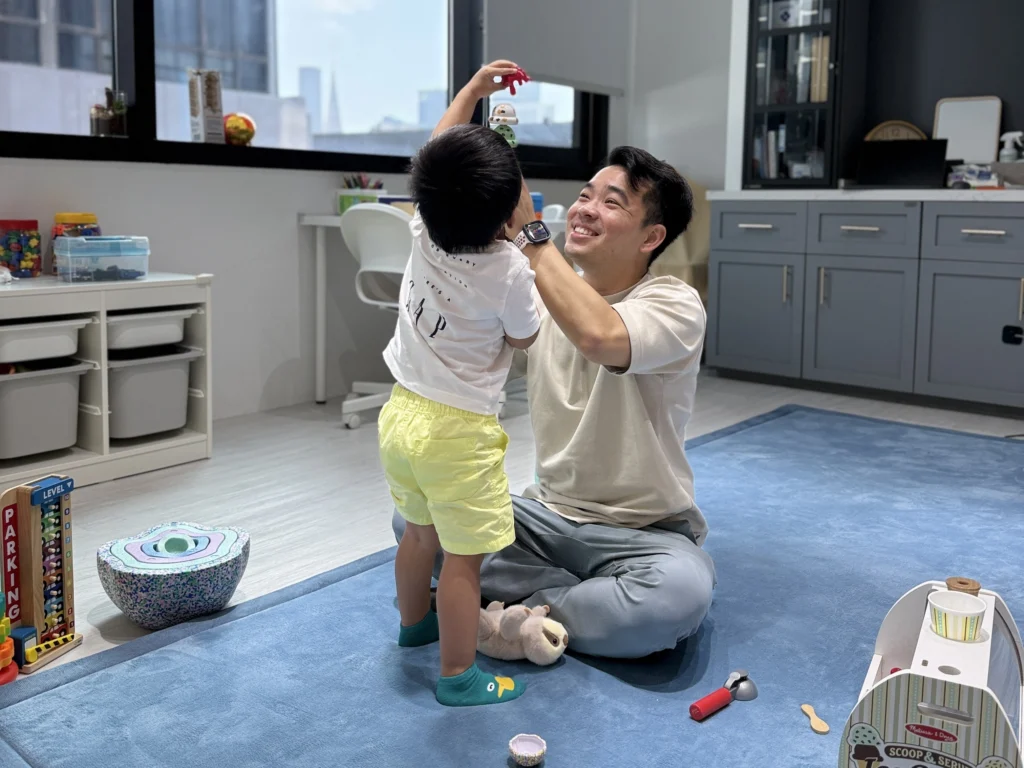
Therapy for toddlers is play-based and follows your child’s lead, built on what they already love. Depending on your child, sessions may use gestures, visual supports, and AAC alongside spoken language, including picture systems such as communication boards, sign language, and speech-generating apps (e.g. TouchChat, Proloquo2Go).
Parents often worry that using AAC will stop a child from talking, but research points the other way. AAC does not hold back spoken language, and it gives your child a way to be understood now.
Sessions are also sensory-informed, so they respect how your child regulates. Our speech delay therapy page explains how sessions are structured.
Caregiver training: your part between sessions
Caregiver training is part of the work, because what happens between sessions matters as much as the session itself. A portion of each session is spent coaching you on strategies that fit your daily routines, such as playtime, mealtimes, and storytime.
For families who want to go deeper, we run structured programmes and workshops through parent and educator training, including Hanen More Than Words, a programme built specifically for parents of autistic children.
Where support happens in Singapore
Families in Singapore typically navigate three routes: public healthcare, government-funded early intervention, and private therapy. They can also be combined.
Public healthcare
Developmental assessment for children under seven runs through the Department of Child Development at KKH or the Child Development Unit at NUH. A polyclinic or CHAS clinic doctor can refer your child, and MOE states that referral through these routes makes you eligible for a subsidy.
A private paediatrician can also assess your child and make the same recommendations.
Government-funded early intervention
ECDA runs a tiered set of programmes, and the referral depends on the level of support your child needs.
Programme
Level of support
Age
Where it happens
Published fees for Singapore Citizens
EIPIC Under-2s and EIPIC@Centre
Medium to high
Birth to 6
Early intervention centre
$5 to $430 a month, means tested
Inclusive Support Programme (InSP)
Medium
3 to 6
Preschool
$10 to $430 a month, on top of childcare fees
Development Support-Plus (DS-Plus)
Low
2 to 6
Preschool
$2 to $290 a month
Development Support-Learning Support (DS-LS)
Low
K1 and K2
Preschool
$5 to $290 for DS, $5 to $130 for LS
Fees are means tested on monthly household per capita income, and the figures above are published by ECDA. EIPIC and DS-Plus require a paediatrician’s assessment, while DS-LS is identified through your child’s preschool.
Referrals into EIPIC go through SG Enable, usually submitted by KKH, NUH or a private paediatrician after assessment. Placement depends on vacancies at your preferred early intervention centre.
Early intervention programmes (EIPIC) typically adopt a transdisciplinary model, where speech therapists work with teachers to develop communication goals, and teachers incorporate these goals into everyday learning and activities. As such, the frequency and duration of a child’s direct sessions with a speech therapist may vary, as therapists work collaboratively with teachers to support the child’s communication goals throughout the week.
Private therapy
Private practices offer the fastest access, continuity with one therapist, and control over which areas you work on. Fees are unsubsidised.
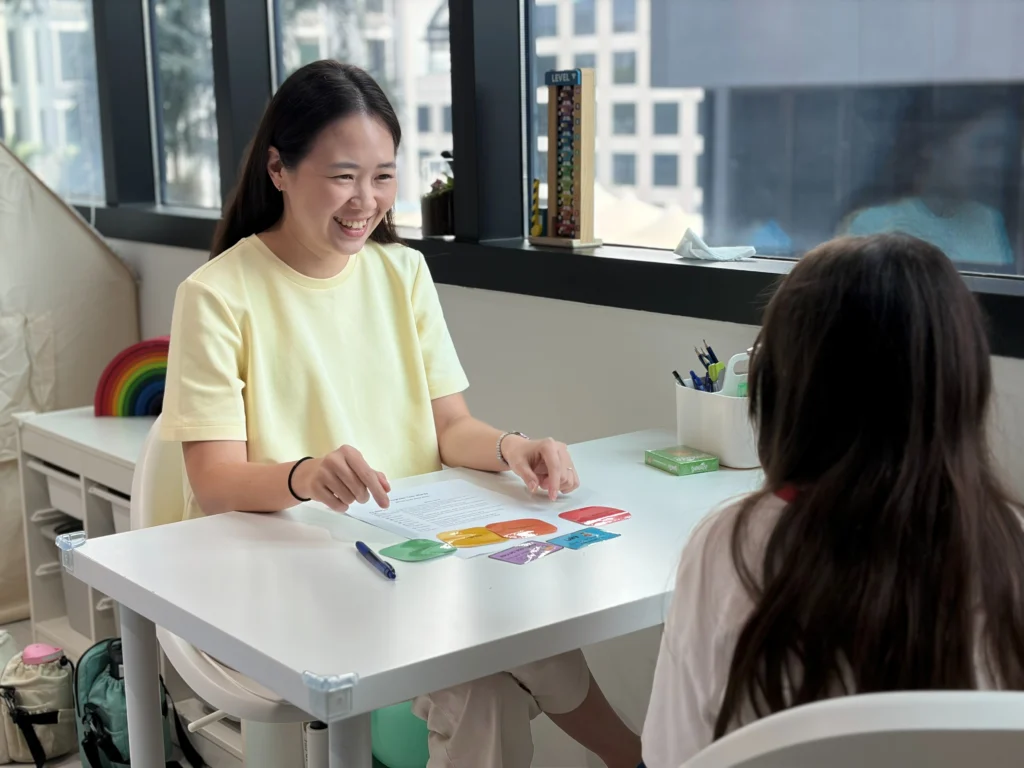
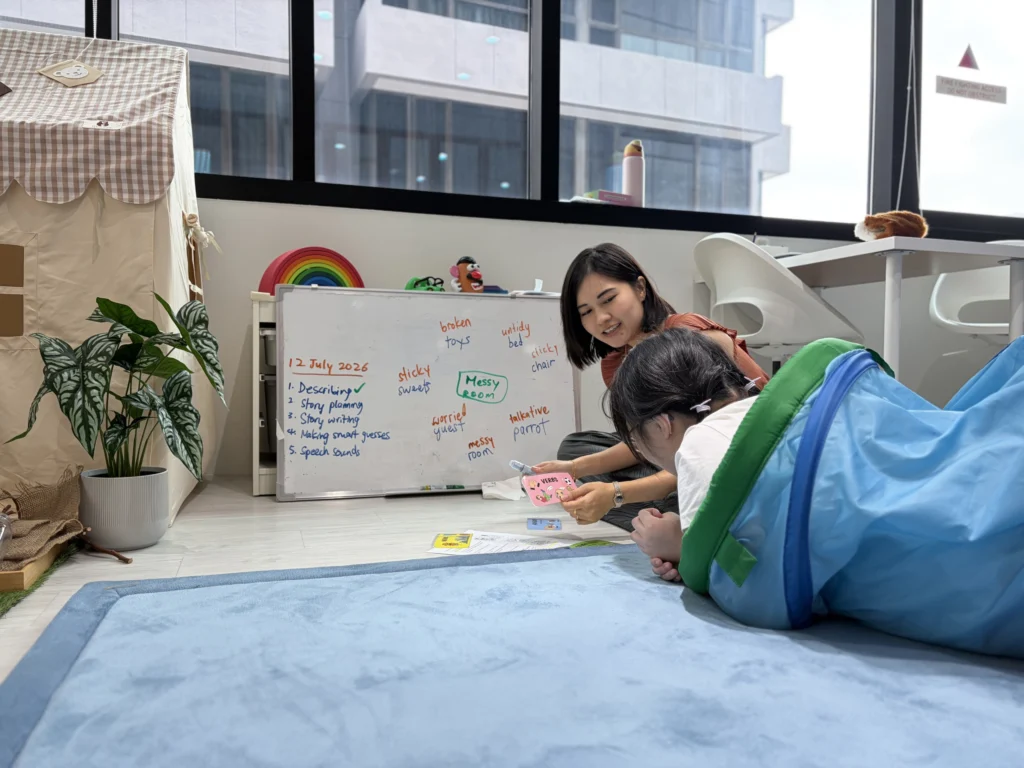
At private clinics like Beyond Speech, children typically receive weekly, one-to-one speech therapy sessions, with parents welcome to sit in, participate in sessions, or receive personalised coaching and strategies at the end of each session.
Both models serve different needs. EIPIC centres may offer a more supportive environment than mainstream preschools for children who require additional assistance, with teachers who have experience supporting children with developmental needs. They may also provide opportunities for group-based activities that support social communication.
Private speech therapy, on the other hand, offers more frequent direct access to a speech therapist and opportunities for individualised intervention and parent coaching. The right choice depends on your child’s needs, the level of support required, and the type of learning environment in which they thrive.
Some families combine routes, for example a government programme for broad support alongside private sessions for focused communication work.
What it costs and how sessions are structured
Our rates are set by the service, not by the diagnosis. Sessions run one hour, and most children start weekly.
Session
Weekday
Weekend
Speech therapy — per hour
$230
$250
Speech therapy — 10 sessions (5% cheaper)
$2,185
$2,375
Home-based therapy — per hour
$280
$280
Home-based therapy — 10 sessions (5% cheaper)
$2,660
$2,660
The one-hour assessment is $230 on weekdays and $250 on weekends, and the full list is on our Fees page. The first phone call is free.
Some autistic children also need support with reading, spelling and learning. That work is educational therapy, and it runs alongside speech therapy rather than replacing it.
At Beyond Speech, both are delivered by speech therapists trained in educational therapy approaches, and children who need both are supported through one combined Speech and Educational Therapy programme.
Starting early gives your child more time and more everyday opportunities to build communication before school demands increase. It is also never too late, because children keep developing communication skills across childhood and beyond.
Consistency and your involvement shape outcomes more than the exact starting age.
The next step
It starts with a free phone call with a speech therapist, where we listen and come to understand your child and your family’s needs. From there, we arrange a face-to-face assessment, and recommend therapy sessions only if they are needed.
Wondering how many speech therapy sessions your child needs? Our article covers what decides the frequency, typical timelines, and how progress is reviewed.
Seet Xian HuiClinical Director, Principal Speech Therapist17 Sep 2026
A parent's guide to how autism shapes communication and how speech therapy helps, covering echolalia, gestalt language processing, AAC, and caregiver training.
Tammy WongClinical Director, Principal Speech Therapist25 Aug 2026
A guide to speech therapy costs in Singapore across public, subsidised, and private settings, what affects the price, and how many sessions children need.
 Seet Xian HuiClinical Director, Principal Speech Therapist17 Sep 2026